
Last Updated: October 22, 2026
Quick Summary
Ceramic window tint vs factory privacy glass reflects different priorities: factory privacy glass is permanently installed during manufacturing for privacy alone, while ceramic window film is an aftermarket product applied to existing glass that delivers superior heat rejection, infrared rejection, and UV protection through nano-ceramic particles.
- Factory privacy glass reduces visible light for privacy but lacks infrared rejection, delivering modest heat reduction compared to ceramic film.
- Ceramic window film blocks 99% or more of UV rays, while factory privacy glass provides only incidental UV protection depending on darkness level.
- You can layer ceramic film over factory privacy glass for maximum heat rejection, but combined visible light transmission multiplies, so verify the result stays legal for your state.
- Front windows typically face stricter VLT limits (50-70% minimum) than rear windows (20-35% or no limit) across most states.
- Ceramic film is removable by a professional technician and comes with installer warranty, while factory privacy glass requires window replacement to change.
Table of Contents
- What Is Factory Privacy Glass and How It’s Made
- What Is Ceramic Window Film
- Does Factory Privacy Glass Block UV Rays
- Does Factory Privacy Glass Reduce Heat
- Ceramic Tint Over Factory Privacy Glass: Compatibility and Results
- How to Match Window Tint to Factory Privacy Glass
- Making Your Choice: Key Performance and Legal Considerations
- Frequently Asked Questions
What Is Factory Privacy Glass and How It’s Made
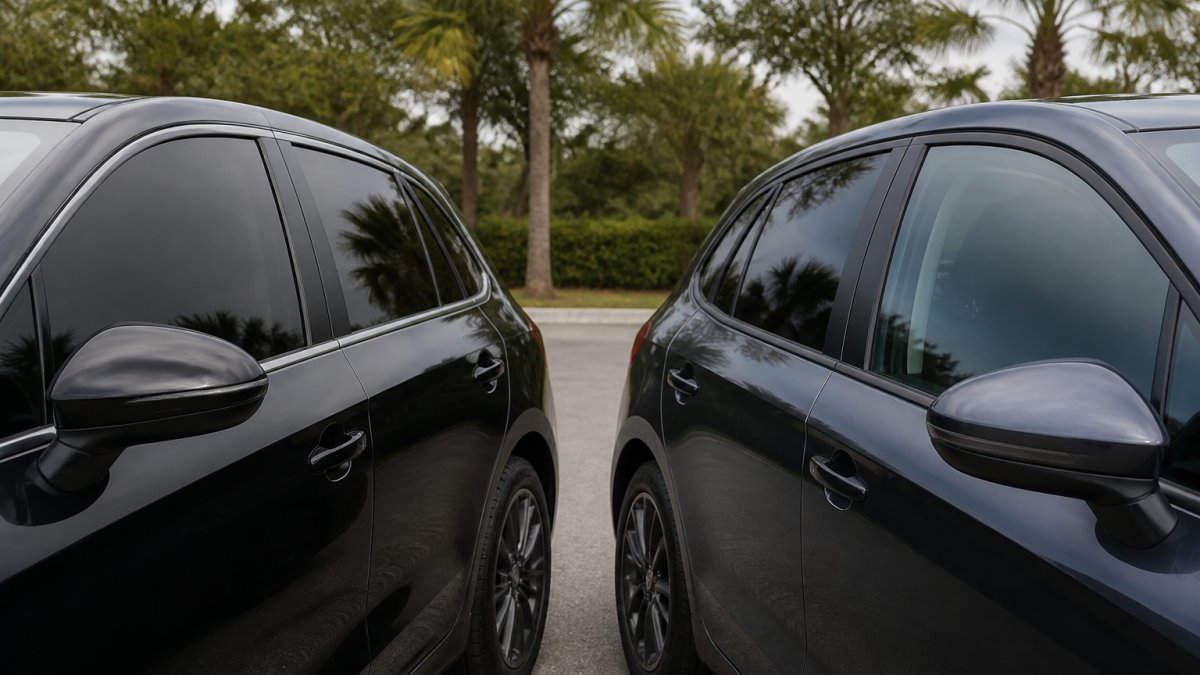
Factory privacy glass, also called factory tint or factory-smoked glass, is automotive glass darkened during manufacturing.
The darkening reduces visibility into the interior and comes standard on rear and rear side windows of most modern vehicles, integrated into the glass structure rather than applied as a surface layer.
The darkening is uniform throughout the glass thickness and cannot be removed without replacing the window, so it maintains consistent appearance and durability over the vehicle’s lifetime.
One important distinction: factory privacy glass is designed primarily for privacy, not heat rejection or UV protection. It may block some solar energy through simple light reduction, but thermal performance was never the goal.
What Is Ceramic Window Film
Ceramic window film is an aftermarket product applied to existing glass. Unlike dyed or metallic films, it uses non-reflective, non-conductive nano-ceramic particles suspended in a polyester base layer.
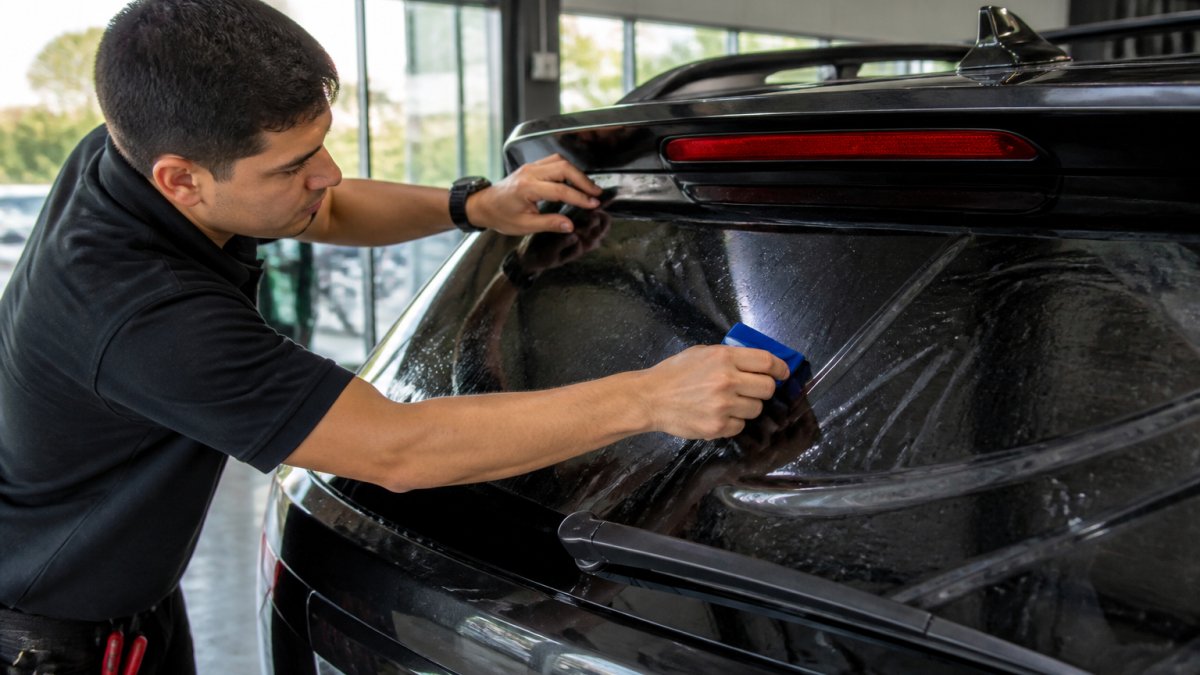
The film adheres to the interior side of your windows with a special adhesive and requires professional installation to avoid bubbles, wrinkles, or contamination.
Ceramic film targets heat rejection, infrared rejection, UV protection, and glare reduction.
Visible light transmission (VLT) varies by product and darkness level, measuring what percentage of visible light passes through the glass-film combination.
Does Factory Privacy Glass Block UV Rays
Factory privacy glass provides some UV protection simply because darker glass blocks more solar radiation, but it was not engineered for ultraviolet rejection. The primary design goal is privacy.
UV blocking depends on glass composition and darkness level.
Prolonged sun exposure fades dashboards, seats, trim, and carpeting, so relying solely on factory privacy glass leaves your interior vulnerable.
Ceramic window film, by contrast, is formulated to block UV rays, with quality films rejecting 99% or more, a more reliable choice for preventing interior fading and protecting occupants.
Does Factory Privacy Glass Reduce Heat
Factory privacy glass reduces some solar heat, but not as most drivers assume. The darkening absorbs visible light, and absorbed light becomes heat in the glass itself; some conducts inward into the cabin, some convects away outside. The net effect is a modest reduction in total solar heat gain versus clear glass, not engineered infrared rejection.
The solar spectrum splits roughly into ultraviolet (about 3%), visible light (about 44%), and infrared (about 53%). Factory privacy glass is tuned to reduce visible light for privacy, not to target the infrared band where most heat load lives, so a dark pane can look private and still let a large share of infrared energy through.
The metrics that actually describe heat performance
Three numbers matter when comparing glass and film, and they are not interchangeable:
- VLT (visible light transmission): the percentage of visible light that passes through. This is the number state tint laws regulate.
- TSER (total solar energy rejected): the percentage of total solar energy (UV + visible + infrared) kept out of the cabin. This is the best single indicator of heat rejection.
- IR rejection: usually quoted for a specific infrared band (often 900-1,000 nm). A high IR number does not by itself mean high TSER, because it ignores visible and UV energy.
In published product data, premium ceramic films commonly land around 80-90% IR rejection for the near-infrared band and roughly 45-60% TSER depending on VLT, while factory privacy glass typically delivers far lower TSER because it lacks an infrared layer. Exact figures vary by product, glass composition, and test method, so treat any single number as a starting point.
Do not compare an IR-rejection percentage from one product against a TSER percentage from another. They measure different things. Ask for the same metric across every option you are considering.
Why the cabin still gets hot with privacy glass
A vehicle cabin is a greenhouse: short-wave solar energy passes through the glass, strikes interior surfaces, and re-radiates as longer-wave infrared that cannot easily escape. Factory privacy glass reduces the visible-light portion entering that cycle but does not stop infrared from entering, so the cabin heats up regardless of how dark the rear windows look.
Ceramic film changes the equation: the nano-ceramic layer absorbs and re-radiates infrared energy rather than passing it through, producing a measurable TSER gain over bare privacy glass, which is why drivers notice the cabin heats more slowly and the AC works less.
What to ask before you buy
Ask the installer for the TSER and VLT of the specific film at the darkness you are considering, plus the same metrics for your existing glass. A shop that cannot produce those numbers is guessing. Compare TSER to TSER, not IR rejection to a visual impression of darkness.
Ceramic Tint Over Factory Privacy Glass: Compatibility and Results
You can apply ceramic window film over factory privacy glass, and many drivers do. The film bonds to the interior glass surface and adds heat and UV performance on top of existing privacy. Two questions decide whether it is a good idea: how dark the combined result becomes, and whether installation is done correctly.
How combined VLT actually works
Visible light transmission multiplies, it does not add. If factory privacy glass measures 50% VLT and you apply a film rated at 50% VLT, the combined result is approximately 0.50 × 0.50 = 0.25, or 25% VLT. A 35% VLT film over 50% glass lands near 17.5% VLT. A 70% VLT film over 50% glass lands near 35% VLT.
That multiplication is why layering surprises people: a film that looks light on a sample card can push an already-dark rear window well below the limit for front side windows in many states.
Ask your installer to meter each pane you plan to film and show you the reading. Then run the multiplication yourself against the film’s rated VLT. If the result is below your state’s minimum for that window position, choose a lighter film or skip that pane.
Legal treatment of factory glass versus aftermarket film
State window-tint statutes generally regulate the total VLT of the window as it sits on the vehicle, not the film alone, so factory privacy glass counts toward the total. A few states treat factory-installed privacy glass differently for inspection, and some programs meter every pane regardless of origin.
Front side windows and windshields are most likely to be restricted; rear side windows and rear glass are often treated more permissively, but not universally. If layering film over factory privacy glass on the rear, confirm the combined VLT is legal there and that any exemption you rely on is documented.
Installation, curing, and compatibility
Factory privacy glass accepts film the same way clear glass does, provided it is clean and defect-free. The practical risks are contamination trapped under the film, adhesion failure along rear defroster lines, and incompatibility with films or coatings already on the glass; a professional installer inspects for these before quoting.
Films typically fully cure over several days to a few weeks depending on humidity and sun exposure, and small water pockets or haze during that window are normal. Follow the installer’s care instructions: no rolling down filmed windows during cure, non-ammonia cleaners only, and no scraping.
Warranty and long-term ownership
Film warranties are typically offered by the manufacturer and backed by the installer, covering bubbling, peeling, cracking, and color change for a stated period but generally not abrasion, improper cleaning, or removal. Also check whether adding film affects any glass or vehicle warranty you rely on; some manufacturers have language about aftermarket modifications, so confirm in writing before installation.
When layering makes sense
Layering ceramic film over factory privacy glass makes sense when you want more heat rejection and UV protection without replacing the glass, and the combined VLT stays legal for the panes you film. It makes less sense when the factory glass is already near the legal limit, when you want a uniform look front to rear, or when the vehicle is leased and you may need to remove the film at turn-in, in those cases, a lighter film on the front panes to match the rear, or no film at all, is often cleaner.
How to Match Window Tint to Factory Privacy Glass
Matching ceramic window tint to factory privacy glass means choosing a film darkness that complements the existing glass color while meeting your performance goals, for a cohesive look across all windows.
Start by identifying your factory privacy glass color and darkness level.
Next, consider local tint laws.
Color matching also matters. Factory privacy glass typically appears gray or slightly brown, while ceramic films come in neutral gray, brown, or green.
Professional installation ensures proper color matching and adhesion; your installer can assess the factory glass, recommend compatible films, and apply them so the result looks intentional and uniform.
Making Your Choice: Key Performance and Legal Considerations
Choosing between ceramic window tint vs factory privacy glass depends on your priorities, vehicle setup, and local regulations.
Choose factory privacy glass if privacy is your primary goal and you’re satisfied with your vehicle’s heat and UV protection as-is.
Choose ceramic window tint if you want superior heat rejection, infrared rejection, and UV protection beyond factory glass.
Legal compliance is non-negotiable.
At Coastal Glass Tinting, we understand these regulations thoroughly and verify compliance before every installation.
The decision in ceramic window tint vs factory privacy glass ultimately reflects your priorities: privacy alone versus comprehensive solar protection.
| Feature | Factory Privacy Glass | Ceramic Window Film |
|---|---|---|
| Primary Purpose | Privacy | Heat & UV rejection |
| Installation | Factory-installed | Professional aftermarket |
| Heat Rejection | Moderate (light blocking only) | Superior (infrared rejection) |
| UV Protection | Incidental | 99%+ blocking |
| Visible Light Transmission | Fixed by manufacturer | Customizable (20-70% VLT) |
| Glare Reduction | Moderate | Excellent |
| Removable | No (requires window replacement) | Yes (professional removal) |
| Legal Compliance | Varies by state | Must verify darkness limits |
| Warranty | Manufacturer | Professional installer warranty |
| Cost | Included in vehicle | Varies by darkness level |
Choosing the right window tint solution protects your vehicle’s interior and improves driving comfort year-round.
Frequently Asked Questions
Is ceramic tint better than factory privacy glass?
It depends on your priorities. Factory privacy glass is designed primarily for privacy and aesthetics, while ceramic window film provides additional heat rejection, infrared rejection, and UV protection. Ceramic tint offers measurable performance benefits for heat and UV rejection that factory privacy glass alone cannot match. Many vehicle owners choose ceramic film over factory privacy glass specifically for solar energy rejection and cabin temperature control.
Can you put ceramic tint over factory privacy glass?
Yes, ceramic tint can be applied over factory privacy glass. The combination increases total visible light transmission reduction and can enhance heat rejection and UV protection. However, the final darkness level depends on both the factory glass and the film’s VLT rating. Professional installation is critical to ensure proper adhesion and avoid bubbling or peeling, especially when layering film over existing privacy glass.
Does factory privacy glass block UV rays?
Factory privacy glass blocks some ultraviolet rays, but not all. Most automotive factory privacy glass filters approximately 50% of UV rays. Ceramic window film provides significantly stronger UV protection, blocking up to 99% of ultraviolet radiation. If your primary concern is preventing interior fading and protecting occupants from sun exposure, ceramic film offers superior ultraviolet rejection compared to factory privacy glass alone.
How much does ceramic window tint cost compared to factory privacy glass?
Factory privacy glass is included as part of your vehicle’s original manufacturing, so there’s no separate cost. Ceramic window film requires professional installation, and pricing depends on vehicle size, film quality, number of windows, and your location. Contact Coastal Glass Tinting for a free quote to get accurate pricing for your specific vehicle or property. The investment often pays dividends through reduced energy costs and improved interior protection over time.
